 AL LARAA
METAL COATING
AL LARAAEvery job that leaves our Ajman workshop is finished using electrostatic powder coating — a dry, electrically-charged application process that gives a harder, more even and more durable finish than liquid paint.
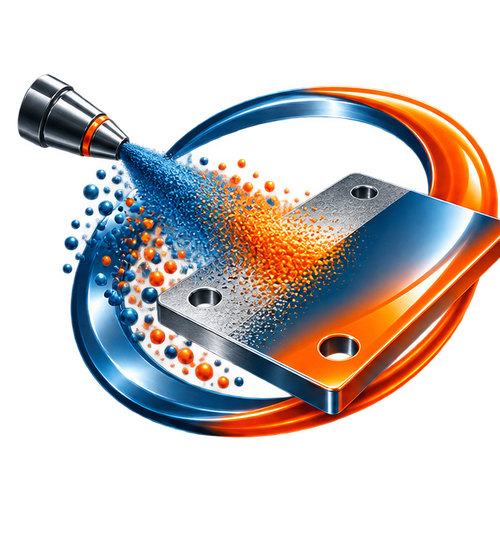
Electrostatic powder coating applies dry powder particles that are given an electrical charge as they leave the spray gun. The grounded metal part attracts the charged powder, pulling it evenly across the surface — including corners, edges and recesses that liquid paint can miss. Once coated, the part is cured in our 3×3×6m oven, where heat fuses the powder into a smooth, continuous, hard-wearing finish. It's the process behind every job we run, from architectural aluminium to structural steelwork.
Electrostatic charge pulls powder into edges and recesses, avoiding the drips and thin spots common with liquid paint.
A cured powder coating resists chipping, scratching and corrosion far better than standard liquid paint.
The powder contains no solvents, and overspray in the booth can be reclaimed and reused rather than wasted.
Aluminium, mild steel, galvanised iron and stainless steel all take an electrostatic powder finish well.
Profiles, cladding, windows, doors and curtain walling in full RAL colour matching.
Fabricated steelwork, poles, brackets and structural components.
Weather-resistant electrostatic finishes for outdoor architectural metalwork.
Alloy wheels and bespoke decorative items finished in-house.
Electrostatic powder coating is a dry finishing process where powder particles are electrically charged and sprayed onto a grounded metal part. The opposite charges pull the powder evenly onto the surface, including edges and recesses, before it's cured in an oven to form a hard, durable finish.
Because the powder is electrically attracted to the part, coverage is more even and consistent than liquid paint, with fewer drips or thin spots. It also produces a harder, more chip- and corrosion-resistant finish, and overspray can be reclaimed and reused, producing less waste.
We electrostatically powder coat aluminium, mild steel, galvanised iron (GI) and stainless steel — covering architectural fabrication, industrial and structural steelwork, gates and railings, and automotive wheels and decorative pieces.
It's generally considered a cleaner process than liquid painting — the powder contains no solvents, and any overspray in the booth can be collected and reused rather than going to waste.